Blog
Words by Melissa Williams – Chief Executive Officer
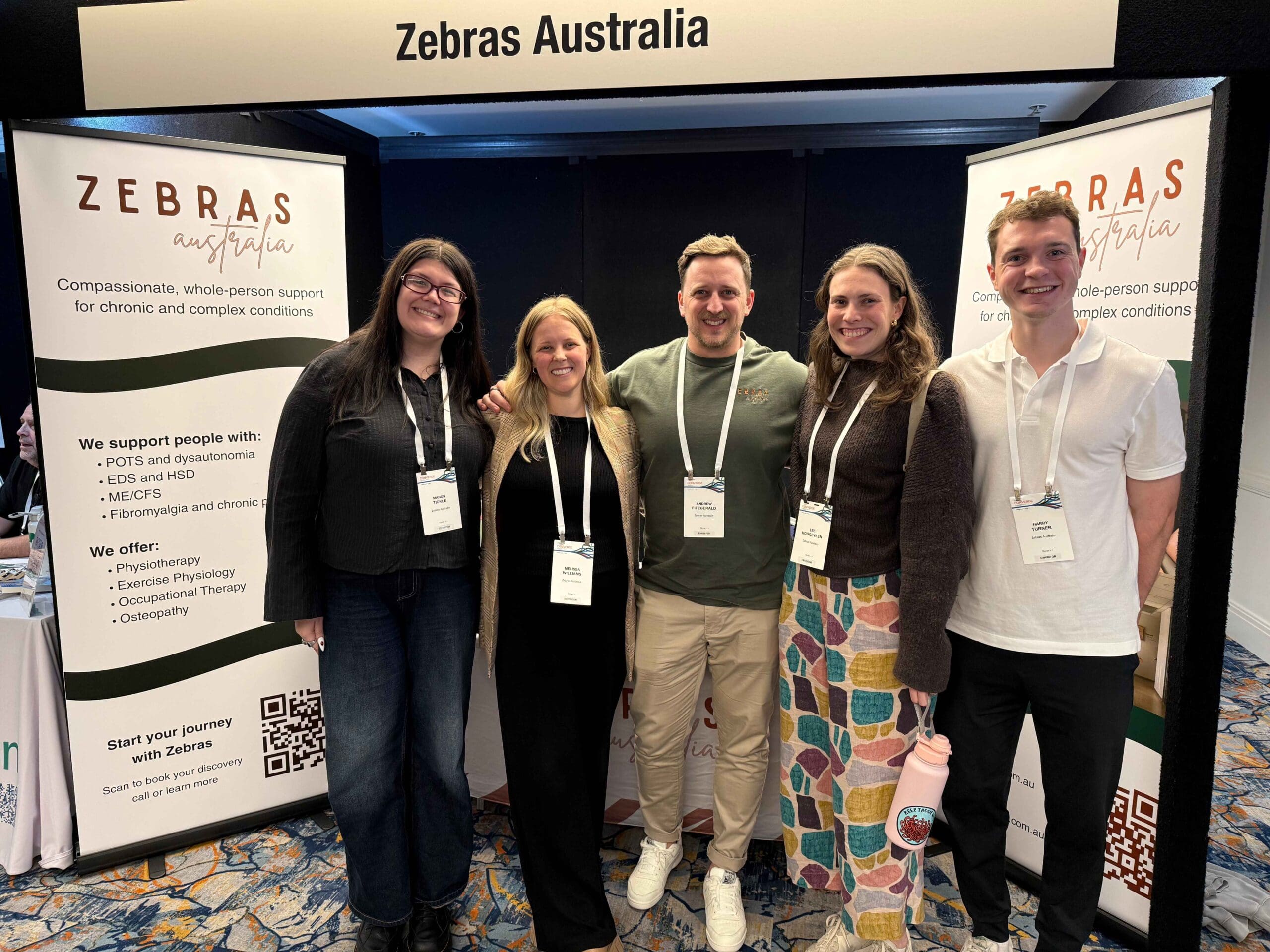
Earlier this month, myself, Andrew and three members of the Zebras team travelled to Adelaide for CONVERGE, the Australian POTS Foundation’s bi-annual conference.
Over two jam-packed days, we joined researchers, clinicians, advocates and most importantly, people living with POTS to learn, connect and share ideas. We heard from local and international speakers, attended (and contributed to) panel discussions and spoke with people whose lives have been impacted by POTS and all that comes along with it.
As with any conference, there was far more information than I could possibly fit into a single blog post. But there were a handful of ideas that continued to surface throughout the week, and a few that have stayed with me since returning home.
What gave me hope
Unsurprisingly for me, the most important thing I took away from the conference wasn’t necessarily a new treatment or research finding (though there were plenty of those).
It was a reminder that people living with POTS deserve to know that their experiences are being taken seriously.
As the largest conference organised by the foundation, the room was filled with clinicians, researchers and advocates dedicated to improving the lives of people living with these conditions. There were discussions about diagnostics, treatment approaches, lived experience, research priorities and healthcare systems.
For a condition that has historically been misunderstood, under-recognised or dismissed altogether, this felt significant.
Awareness is growing. Research is growing. And more people are working hard to improve the experience of those living with POTS.
There is still a long way to go, but there is momentum.
Complex conditions require continuous thought
This idea, shared by Dr Alexis Cutchins, really stood out to me.
Complex conditions require continuous thought.
Not a one-off assessment. Not a single intervention. Not one practitioner holding all the answers.
Many of the conditions we support at Zebras don’t follow a predictable path. Symptoms fluctuate. Capacity changes. Life circumstances shift. What works during one season may not work during the next.
For people living with POTS, healthcare can sometimes feel like a search for the one thing that will finally fix everything.
The reality is often more nuanced than that.
Supporting complex conditions requires curiosity, ongoing learning and a willingness to continually revisit what is helping and what isn’t.
No singular discipline holds all the answers
Another recurring theme throughout the conference was the importance of interdisciplinary care.
Again and again, speakers spoke about the need to treat the whole person whilst acknowledging that no single practitioner can hold the entire picture alone. This was refreshing to hear.
At Zebras, we often talk about the fact that people shouldn’t have to become the coordinators, translators and advocates of their own healthcare. And yet many people living with POTS find themselves doing exactly that.
Navigating countless appointments.
Connecting information between providers.
Repeating their story over and over again.
Trying to make sense of conflicting advice.
Complex conditions require collaboration. Not because every practitioner needs to know everything, but because each discipline looks through a different lens.
Simply put: when we work together, people receive better care.
Working with your body, not against it
One conversation that came up repeatedly throughout the conference was the role of pacing, trigger identification and symptom management.
For many people living with POTS, there can be a fine line between encouragement and pressure. Messages such as “push through” or “just keep going” can sometimes leave people feeling as though they are failing, especially when symptoms worsen. The conference reinforced something we discuss regularly with clients. Avoiding triggers is not necessarily the same thing as avoidance.
For someone living with POTS, understanding what aggravates symptoms and making thoughtful adjustments can be an important coping strategy. This isn’t about shrinking your life, but understanding your body well enough to make informed decisions for your health and wellbeing.
Sleep deserves more attention
Sleep emerged as another important theme throughout the conference.
This may not sound particularly exciting, but it matters. Sleep influences nervous system regulation, sensitivity, symptom burden, recovery and cognition to name just a few. And yet, it can be easy to overlook.
The conversations at CONVERGE were a helpful reminder that sleep is not simply a lifestyle factor, but a meaningful part of holistic symptom management.
Education is one of the most powerful interventions we have
I may be a little biased, but one of the simplest ideas discussed was the value of education.
Helping people understand what is happening in their bodies can be incredibly powerful. Education doesn’t eliminate symptoms but it can reduce fear, improve confidence and help people make sense of experiences that may have felt confusing. When people understand why symptoms occur, they are often better positioned to respond to them.
Knowledge doesn’t solve everything, but it can go a long way.
Advocacy is brave
Perhaps the thing that moved me most was the people in the room.
People bravely sharing their stories, advocating for change and educating others despite managing symptoms of their own.
Advocacy can be a vulnerable thing. It requires people to speak openly about experiences that have often been dismissed, misunderstood or minimised. Many of the advances we are seeing today have only been possible because people living with these conditions were willing to keep searching for answers.
That takes an immense amount of courage.
A final thought
I’ve returned from Adelaide feeling more hopeful than ever.
I have hope that more clinicians are learning about these conditions and working together in new ways. Hope that people living with POTS will have greater access to information, support and care.
Yes, progress can feel frustratingly slow at times but sitting in a room full of researchers, clinicians, advocates and people with lived experience, it was impossible not to feel that progress is happening.
And for many people living with POTS, that’s worth holding onto.